Aaron's Nighttime Chase and Run with Grace
Cat PersonThe event marks a turn in Aaron’s last night in the village: fear and humiliation give way to a strange, wordless run with Grace, just before he is due to leave for home. What begins as a possible threat at his house becomes a pursuit across the settlement and ends among the girls he has come to help, where the scene’s danger is recast as play and recognition.
Background and Uneasy Departure
At sunset on his final day in the village, Aaron walks into the center for the last time. He buys a chapati and a Coca-Cola, then pauses and buys a second set for Grace. As he imagines how she will react to his departure, her teasing about the Peace Corps’ failure to prepare him for night runners comes back to him. He privately recognizes how little he has learned about what he needed to know. The exchange gives the coming night an immediate connection to Grace: she is absent, yet her voice and the local stories she has shared shape what Aaron expects and fears.
The night initially brings no Grace and no runner, only oppressive heat inside the house. Aaron, uneasy but unwilling to open the windows, sits on his mattress in his underwear with a long, flat blade from the yard shed across his lap. He has told his supervisor that he does not feel endangered in the village; his private state is more complicated. He feels unsettled, humiliated, and powerless, and is tired of those feelings. The weapon and his vigil show him preparing for danger even as his earlier assurance suggests he does not believe the danger is straightforward.
The Disturbance at Aaron’s House
Shortly after midnight, knocking begins at the door and windows. It moves from one side of the house to another so quickly that Aaron imagines more than one person is outside, perhaps a group of girls. He recalls one girl’s earlier defiance and recognizes the contrast between her lack of fear and his own crouched position indoors. He has come to the village to help, but now sees himself as a coward. When the knocking spreads around the house, he shoulders the blade and approaches the door.
Aaron opens it abruptly. A pair of bare legs swings into view, and one kicks toward him; he reacts by swinging the blade. The figure escapes upward, leaving the blade lodged in the old doorframe. Aaron is shaken by the possibility that he might have struck someone. The encounter turns his fear into horror at his own near action: the threat is no longer only what may be outside, but what he himself might have done in panic.
The runner appears to move onto the roof, where the knocking becomes a light tapping. Aaron goes into the yard and catches sight of a small shadow crossing the sloping roof. He calls to the girls by name, asking them to come and talk, but receives no answer. A sound from the far side of the house draws him around; then a mocking meow comes from behind him. The unseen figure has made him turn repeatedly, unable to establish where it is or how it moves. His attempt to speak gives way to anger, and when he lunges to catch the runner, it slips past him and out through the gate.
The Chase Through the Settlement
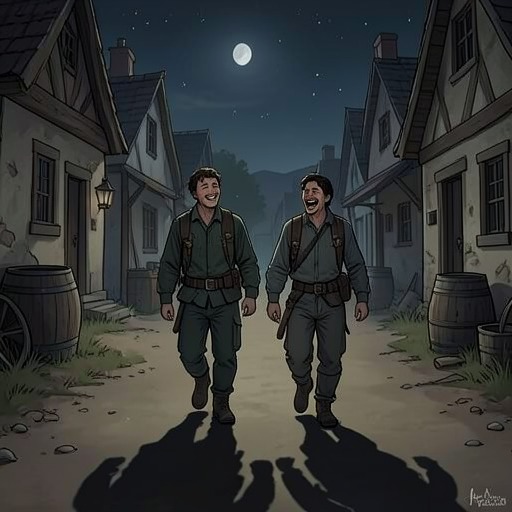
Aaron runs after the figure into the dark street, barefoot and still in his underwear. He forgets his exposed state and follows the moving shadow, which seems to change in size—from childlike to man-sized, then cat-sized and back to the proportions of a girl. The chase crosses empty streets past closed houses and shops, then continues through wet shrubs and a stand of taller trees. Aaron’s route carries him beyond the church and the dump, across a field of maize, and over a wall into a compound lit by flames.
The landscape makes the pursuit feel both physical and disorienting. Aaron is no longer watching safely from inside his house: he has been drawn out beyond its boundary, across places he knows, following a figure whose shape will not stay fixed. His anger propels him, but the chase also strips away the distinction he had made between a protected volunteer and a threatening stranger. By the time he reaches the compound, the people there see him before he understands where he has arrived.
Recognition and the Run with Grace
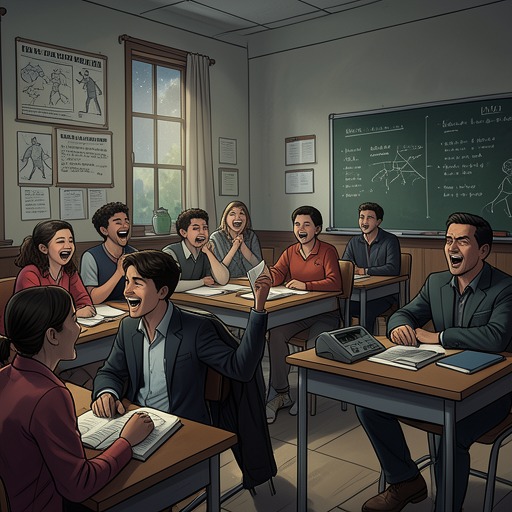
The fire belongs to a celebration marking the end of the semester. Aaron recognizes the compound and the school building behind the crowd. The Girls of First Middle School are gathered around the fire with girls from other grades; many hold cans of Coca-Cola or Fanta and have eaten roasted goat. For a moment Aaron cannot distinguish people from shadows, and a shape that seems to be a tall, thin man resolves into a flagpole. The familiar gathering brings the night’s strange pursuit into an ordinary communal setting.
The girls stare at Aaron, and one points at him in fear. He turns, briefly believing in the creatures from Grace’s stories, then sees only the bare wall behind him and understands that he is the pursuer, not the pursued. Some of the younger girls cry; Roda Kudondo calls him a night runner, and the frightened reaction shifts into teasing. Aaron sees himself through their eyes as a frightening outsider, disheveled and covered in dirt and leaves. Their jeers, rather than isolating him, form a protective ring around him; he thinks of the girls as brave.
Then Grace calls softly from a corner of the compound. She is the person who has never feared Aaron, who has laughed at him, teased him, and told him stories. Instead of crying or scolding him, she runs. On the night before his long journey home, she crosses the courtyard naked, visible to Aaron alone. He follows her, agile as a cat. The ending does not explain the runner’s changing shape or Grace’s invisibility to the others. Instead, it changes the emotional charge of the chase: what began in suspicion, fear, and the risk of violence concludes in a shared act of motion, with Aaron no longer alone in the dark.